
Over 2 decades with HEAT Consulting, Business Analysis, and Project Management have taught me and reinforced, is that the customer isn't always right and neither is the consultant. Looking at who is right is wrong! Instead of building a law case and looking to disprove one another, everyone needs to TRUST THE PROCESS.

Category: Best Practices
What is the difference between an Incident, Problem, and Service Request?
Incidents are Break/Fixes for issues where something was working but stopped working, a single unplanned event that causes a service disruption. Service Requests are for requesting new Services or changes to existing Services
How to show Customer History using Quick Action
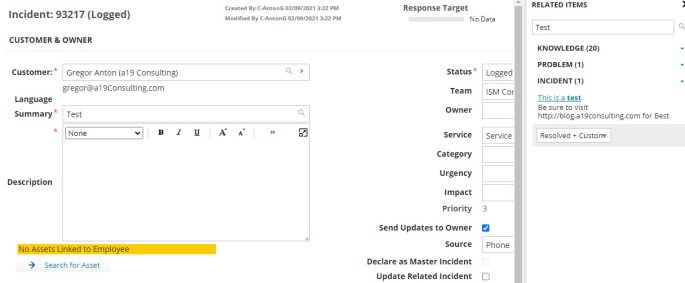
One of the HEAT Classic Features that is frequently requested is to bring back the customer history. There are several implementations for this, yesterday covered how to implement Incident Customer History for Related Items, aka Object Matching, today we will cover how to show Customer History using a Quick Action. Create a UI Quick Action for IncidentScope: ObjectWorkspaceCommand ID: SearchConfirmation: … Continue reading How to show Customer History using Quick Action
How to show Customer History in Related Items (Object Matching)
One of the HEAT Classic Features that is frequently requested is to bring back the customer history. There are several implementations for this, today we will cover how to implement Incident Customer History for Related Items, aka Object Matching.
Email, productivity tool or time-waster?
Email was great back in the HEAT Classic days. It's time to face the news and re-evaluate when and how to use Ivanti ISM (HEAT) email notifications to communicate more efficiently and implement best practices.
Waiting for Resolution Incident Status
A very frequently asked question when implementing Ivanti Service Manager (HEAT) evolves around the "Waiting for Resolution" Incident Status. What is its significance, should it be used, and how does it effect SLAs?
Ivanti Service Manager Milestones
video posting on the topic of Ivanti Service Manager (HEAT) Milestones which are the basis of Ultimate Ivanti HEAT Implementation Success Factors!
What is a Soft Go-Live?
A soft go-live, also know as soft launch, can be a preview release to a limited audience prior to the general user base, for example if you're rolling out Ivanti Asset Manager, with Asset Scanning, Procurement workflows for Purchase Orders, Product Catalog for Hardware and Software, Storage Locations to manage consumables and Packing Slip scanning, there are bound to be some new procedures that need to be tested in the real world. With real live situations.
What is Regression Testing?
Regression testing refers to testing of existing functionality to ensure that recent changes do not adversely affect existing features. For example, when implementing Asset Management, the existing Incident functionality is tested to test use cases such as creating an incident, creating a task, updating incidents, closing tasks, incidents, etc In addition to UAT Test Scripts, you will want to do … Continue reading What is Regression Testing?
Best Practices – UAT
When it comes to Ivanti Best Practices for User Acceptance Testing (UAT) there is no better source than that of a seasoned Consultant with the voice of experience of years of Ivanti Professional Services, Ivanti Implementations, Upgrades, with Ivanti Service Manager (powered by HEAT IT Service Management) and Ivanti Asset Manager


You must be logged in to post a comment.